Tag: lifestyle

Make Candy Boxes Easier to Open

You could wrap your candy in beautiful paper and create a nice problem for yourself if you put a tight-lid on it. Some customers are going to have difficulty opening some types of candy because their hands will hurt; they’ll have weak finger muscles; they won’t be able to see well; or they won’t have a good grip. Additionally, many customers will need to open packages holding children. Candy boxes should protect what’s inside but should never make the customer feel like he has to “unlock” the candy. Helping many more customers enjoy treats is easier if there’s an easier way to open these containers.
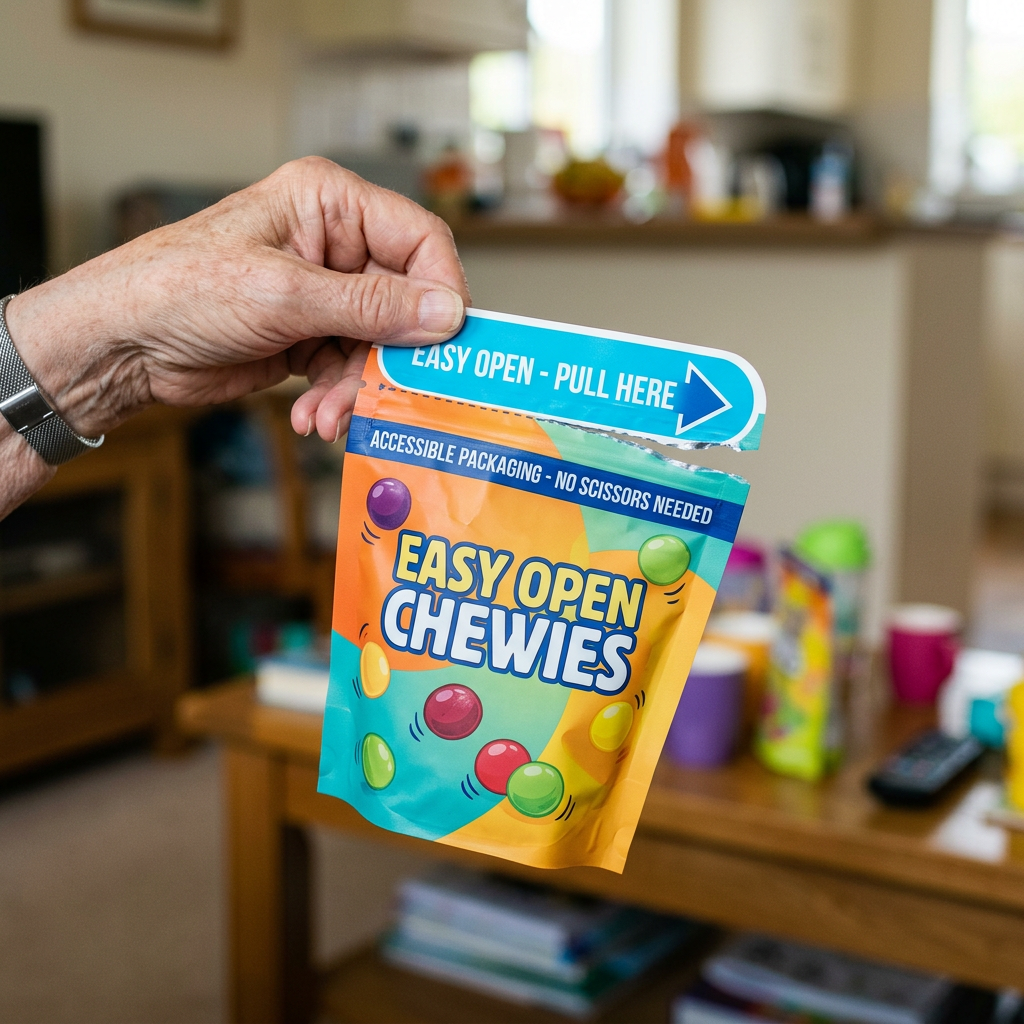
Hand holding colorful Easy Open Chewies pouch labeled accessible packaging
A hand holds an easy-open Chewies candy pouch designed without scissors.

Begin by thinking about the relationship between the lid and the base of the container. The lid may look great when you’re handing it over to the customer, however, this may prevent them from pulling the lid off the container. On the other hand, a lid that’s too loose will come off very quickly when pulled. The ideal connection (the lid fits perfectly onto the base) remains closed during handling and comes off easily with a slow, consistent pull. A series of sample testing reveals problems that cannot be seen using only drawings.

Adding tabs, thumb cuts, and/or wider areas to aid in gripping provide the customer a clearer location to begin opening. However, adding a ribbon provides an additional method for lifting lids and requires careful placement. Do not include elements that require nail sharpening or significant pinching. If adhesive tape or labels seal the package, leave a portion of the area that allows the customer to lift the seal without cutting.

The type of finish used on the surface affects how easily customers can grasp the box. Glossy surfaces may slip out of dry hands whereas a light textured surface will provide a better grip. Darker colors may also obscure the distinction between the top and bottom. Using a distinct color change around the opening may help customers locate where to pull on a dull day.

Test the sealed filled box using both hands and again using one hand while wearing thin rubber gloves. Test each prototype with customers of all ages and ask them to attempt to open the container without showing them how. Observe which part of the box they first reach toward, how long they hesitate before attempting to open it, and whether they rotate the box to determine where to pull. These actions typically indicate more information than simply asking the customer questions after the trial.

Easily accessible packaging does not mean the packaging is weakened. The candies must continue to be contained once moved or sold. Any modifications made should be tested under full load conditions. Hold the closed container upside down and shake it back and forth. If the lid moves around, make adjustments based upon your findings and repeat the testing process.
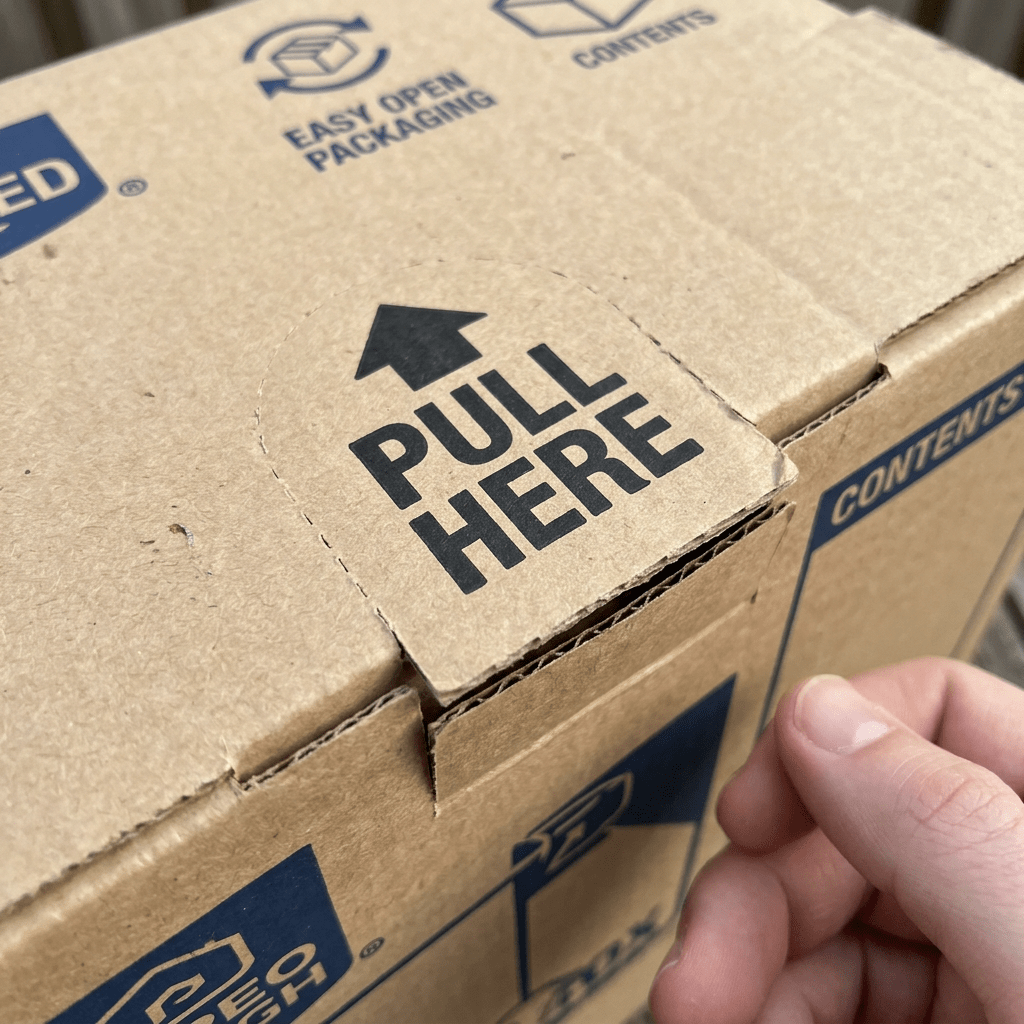
Hand pulling a cardboard box tab labeled “PULL HERE”
A hand pulls the perforated tab on a cardboard box marked “PULL HERE.”

If necessary, providing instructions can assist customers who find it difficult to identify where to pull. It may take just a couple of short phrases such as “pull here” to allow the customer to understand where to start. When creating instructions use large print lettering so customers can easily read them and position them adjacent to the component that moves. Your objective is not to place a plethora of instructions on the packaging, but rather eliminate the single area in which a customer becomes stranded.

When considering thoughtful packaging options for candies, we should not focus solely on assisting older adults or those with disabilities. The new packaging designs should be equally accessible for all consumers without drawing attention to either their age or disability. The design should clearly show where to pull to gain entry into the container; be securely fastened until desired; and allow customers to access their treats with minimal effort. This modest consideration can convert packaging from a hindrance into a useful tool for facilitating sharing among all consumers at the table.
Make Candy Raise Community Support

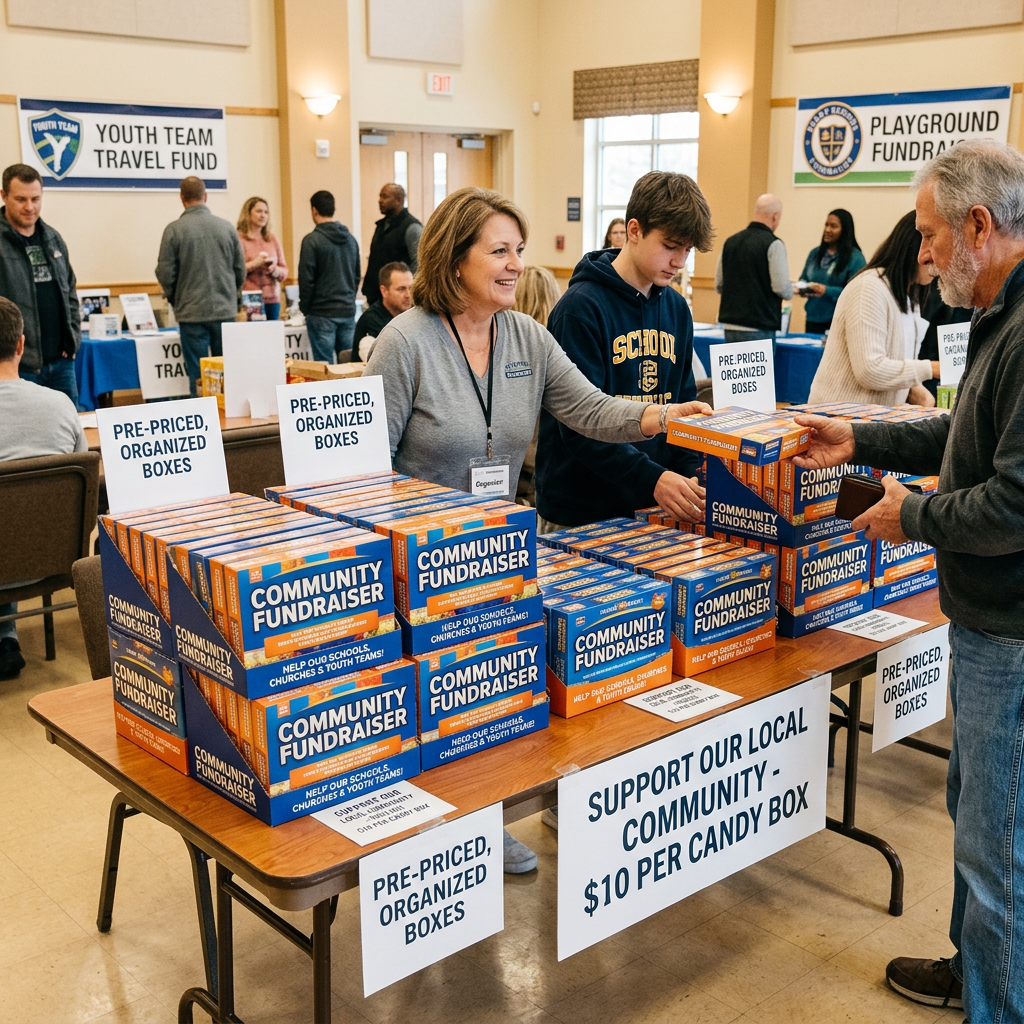
Schools want to purchase playground swings. Churches have plans to gather non-perishable food items for their local communities. Youth teams require assistance to fund their upcoming travel. While all of these organizations would be able to sell sweets, loose candies may appear disorganized and create uncertainty regarding pricing. Candy boxes provide an organization with a straightforward method of transforming individual purchases (of relatively inexpensive treats) into a product consumers can feel positive about purchasing.

Community fundraiser table with candy boxes, volunteers, and signs reading Youth Team Travel Fund, Playground Fundraiser, and $10 per candy box
Volunteers and families gather to sell pre-priced candy boxes supporting local youth programs.

Step #1: Identify Your Goal: Clearly identify what you wish to accomplish from your candy box fundraiser. The greater clarity there is regarding the ultimate destination of the funds collected, the more inclined potential donors will be to contribute. An example statement identifying your goal could be “the funds we collect go toward the purchase of books for our library,” “the monies raised go toward providing meals for individuals at risk of hunger within our community,” or “the funds collected go toward paying for athletic equipment/sports fees.” Write this statement on the box and include the name of your organization.

This allows potential contributors to clearly recognize both the purpose behind the purchase and the organization making the request.

Step #2: Determine How Much Candy Will Be Included Within Each Box; Decide How Many Pieces of Candy Each Person Should Get. Before determining a price point, determine how many pieces of candy each person will receive. Consider how many people you anticipate selling candy to. Twelve small-sized pieces of chocolate may generate more revenue than four larger chocolate bars if your objective is to attract as many customers as possible. Also consider using consistent amounts within each box to avoid creating issues with unequal portions among buyers. By consistently packaging a similar amount of candy in each box, the process of packing will move quicker for volunteers and allow for a more accurate accounting of funds generated during the event.

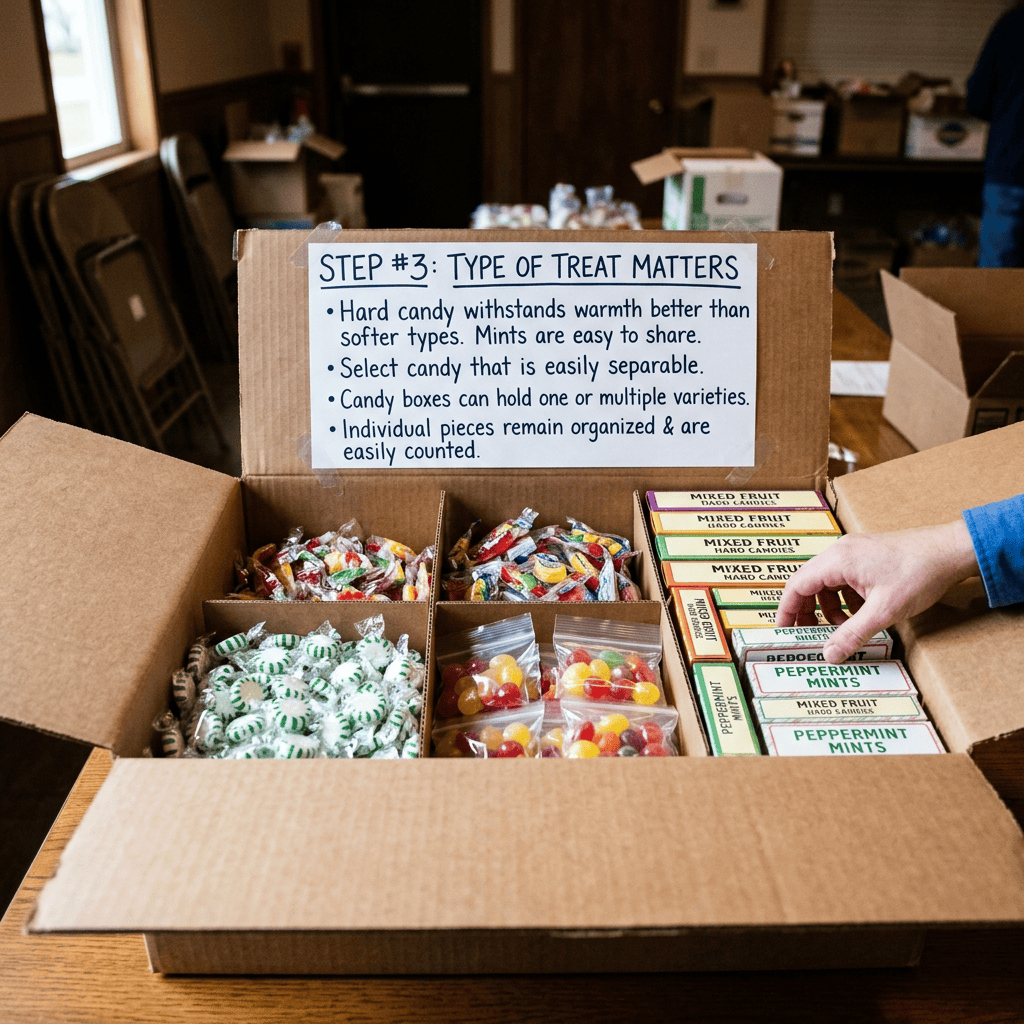
Step #3: Type of Treat Matters. There are different types of candy available depending upon how well they withstand warmer temperatures. For instance, some types of hard candy can withstand warmer environments longer than softer varieties such as chocolate. Mints that are wrapped individually may be easier for children to share than chewy candies. If children are expected to participate in assisting with sales, select candy that is easily separable from other candies. Additionally, candy boxes can be filled with one variety of candy or multiple varieties provided the individual pieces remain organized and are easily counted.

Boxed candies beneath sign reading STEP #3: TYPE OF TREAT MATTERS, with sorting instructions and labeled peppermint, mixed fruit, and hard candy boxes.
An open box sorts assorted candies beneath instructions for choosing treats that store and share well.

Step #4: Food Label Requirements Must be Carefully Considered. Some candies contain ingredients which are common allergens such as milk, peanuts, tree nuts, soy, or wheat. Include either the manufacturer’s label or list those ingredients where they can be seen/read by prospective purchasers. Never state that a specific treat is safe for someone who has a known food allergy unless you are absolutely certain that the ingredient(s) listed do not pose a problem. Maintaining cleanliness throughout the entire process (hands and surfaces) will enable the group to properly prepare the candy boxes.

Step #5: Test Run. Conducting a trial/test run prior to distributing candy boxes to prospective buyers can assist in preventing problems on distribution day. Prepare all materials including the candy, labels, tape, and completed boxes in a sequence representative of how volunteers will access them during the actual event. Measure how long it takes to complete 10 boxes. In doing so, you can quickly assess if additional support staff members are needed, if additional supplies are required, or if another area/location will be necessary for distribution/packaging.

Step #6: Where & When to Sell: Determine where and when to conduct your candy box fundraiser. Events such as school games, craft fairs, church functions and/or town festivals/centers are excellent places to find the target audience for your organization. Display a clear and descriptive sign listing the cost per box and highlighting the purpose/goal of your fundraiser. Once potential donors understand why they are being asked for financial contributions, even a small box of candy will seem like a significant contribution.

Liquid Packaging Logistics to Reduce Risks with Fluid Transit 

One thing that does need to be transported is fluids. Whether it’s medications, drinks, or even some sort of over-the-counter item, you will need to have to transport it safely.

The problem is some items can be very dangerous if they leak. Corrosives and highly-flammable chemicals can cause large-scale explosions and problems if they are not properly packaged. When that happens, that falls on you, the company.

So to prevent that, you need to use the right packaging logistics to reduce risks with fluid transport. Here, we’ll go over how to do it in a manner that’s safe, efficient, and also will prevent disasters from happening. 

Innovative Solutions 

These days, you already know about the box and filling it with a cushioning void fill to fill in the gaps. There are other solutions however, that can help a lot of packaging get to its destination. 

The first are leak-proof materials.   There’s usually hardened plastic and glass that have  seals to prevent the liquid from getting anywhere. Airtight sealing is one of the most common ways to do this too.

Putting the liquid in an airtight compartment with a molded packaging will keep everything inside. putting a strong, durable film on there with an adhesive that’s leak-proof also prevents this.

You also, however, need to think about the overall receptacle. Keeping them in large boxes is a good way to ship many items, but you also want something that’s shock-absorbent. Keeping them in hard, shock-absorbent containers such as plastic is a commonality for a lot of brands. 

You might also use foam to create a bed for these items, in order to make this easy to absorb, as it will be good for a lot of customers to have. 

The Industries that Benefit 

There’s a lot of good industries for this. perfumes is one, because you don’t want that highly-expensive liquid to get all over the place. Obviously drinks and beverages, whether it’s sodas or energy drinks, or even instant coffees, benefit from this. 

Industrial chemicals are one of them. if you have something that’s highly degrading and corrosive, it’s especially important it stays where it belongs. Acids, flammable items, and the like all need to be housed correctly.

Finally, there’s chemicals. These chemicals are easy to put in a receptacle, and from there, can be properly kept away from the breakdowns and spills.   Foundations, concealers, and the like all benefit from such.

The environmental impact 

With this type of packaging, you do need to figure out lightweight and biodegradable solutions.   There is now biodegradable plastic, which can be used for some of these items. It might not be fitting for all, however.

In that case, optimizing the space and providing as best of an eco-friendly experience that’s lightweight is the next best option for you. 

Future of This Packaging 

Smart packaging is on its way, and it will be used with liquids.  

For example, there might be sensors put in that will monitor the current liquid inside. if there is a leak, it will alert the person at the destination, and also can help inspection teams catch this before it gets bad.

The other one is a sensor for temperature changes. For some items like medications and chemicals, it has to be stored in a certain area. These sensors can catch the changes before it gets bad, and also adjust the packaging immediately, so that everything is kept safe, secure, and easy for you to use.

Overall, there’s a lot of benefit to be had with this packaging and you should definitely use it for transporting liquids.