You could make money at a candy store all year round, but if you don’t have an idea of what your true costs are, you’ll probably make almost nothing. Maybe it’s not even the candy itself. Even if you charge enough to cover the cost of the sugar and chocolate, you may still lose on packaging. Paper cups, candy boxes, labels, energy (electricity), broken pieces of candy – there are a lot of costs besides just the candy. Once you know what your true costs are, you can start turning your job into a successful business.

Take one order of candies and write down everything that was spent on each ingredient. Small items like flavoring, nuts, oil and decorative items should also be included. Don’t include the entire cost of something (such as a large bag) simply because you only used some of it. Divide the total cost of the item by the portion used so the cost remains proportional to the usage.
After writing down all of the costs for this order, now find out how many individual pieces of candy were made. Do not include broken pieces of candy; test pieces; or pieces of candy that were sampled. Since you know how much it cost to produce this order ($30) and how many pieces of candy fit to sell (100), now calculate the cost per piece of candy prior to packaging. For example, since each piece of candy has a cost of 30 cents prior to packaging, a box containing 10 pieces would contain $3.00 worth of candy.
Costs associated with packaging belong in the calculations. In addition to the candy box and cup, you must consider other costs such as pads, ribbon, stickers, printed cards and any outer bags used for sales. Although a few cents might seem insignificant to track, multiple small items can equal more than a dollar. This lost dollar can become thousands of dollars over the course of numerous orders.
There is another expense that sellers commonly overlook — time. Determine how long it took to prepare, cook, cool, sort, pack, seal, and clean up after completing one order. Next, choose a reasonable hourly wage based upon your desired compensation. Finally, divide this hourly wage by the number of completed boxes to determine if a specific cost related to a box (i.e., a fancy bow or handwritten label) has taken longer than what you believe customers will pay for.
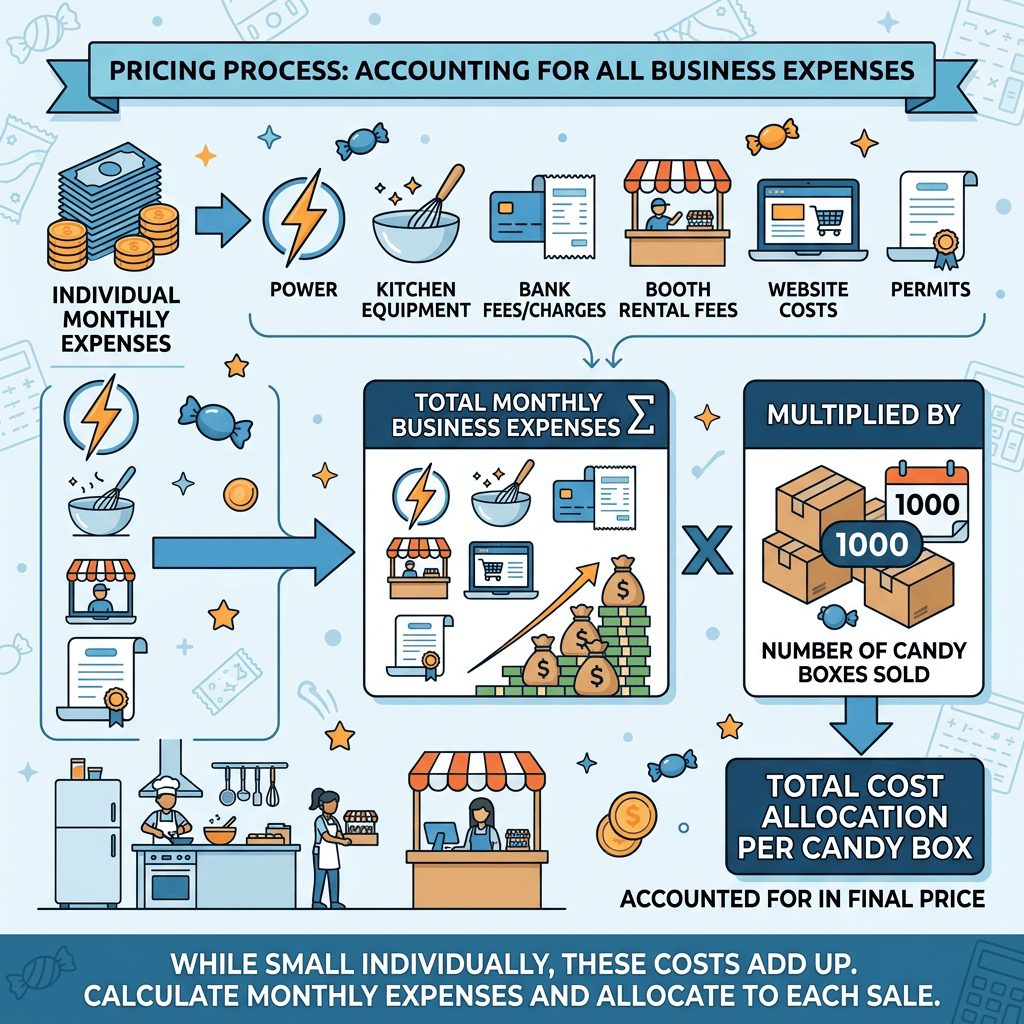
All business expenses that benefit each sale (power, kitchen equipment, bank fees/charges, booth rental fees at markets, website costs and permits) need to be accounted for in the pricing process. While these costs may be small individually, they can quickly add up. When accounting for these costs you must multiply them by the number of candy boxes sold during a month.
Now combine the total cost for candy, packaging, labor and shared business expense for one box. This is referred to as your “break-even” point (not your selling price). To maintain profitability and provide funds to replace tools and equipment and account for slower sales periods you must add a markup to exceed this break-even point. There isn’t a standard mark-up for all shops since local buyers and quality of product vary greatly.
Finally, review your final price compared to those similar treats being sold within the same general area. Is your price significantly higher than others? If so, you likely use better ingredients, give customers larger portions or provide a unique service to justify this increased price. On the other hand, if your price is lower than comparable products sold near you it may indicate that a cost was left unaccounted for. Re-evaluate your calculation when suppliers increase prices on supplies. Accurate records enable sellers to establish fair pricing and clearly communicate with consumers regarding quantity discounts or special promotions and gifts given away at community events without unknowingly damaging their personal financial income.

