Tag: travel

The purpose of Heavy Duty boxes 

Maybe you’re looking to ship stuff that’s bulky, valuable, or super heavy. Heavy duty boxes are about to become your best friend. They aren’t just the same old boring cardboard boxes, but they’re superheroes, ready to take over the shipping world.   Here, we’ll go into the heavy duty box world, and why they’re ideal for packaging.

 The lowdown of Heavy duty Boxes 

Now that you know about their presence, you might wonder a little bit about them, and why they’re special. 

First, it’s the material. Most of them are made with corrugated fibers, which offer the supreme combination of both strength and a lightness that comes with the fluted inner lining. So also throw in there the mailer boxes that are heavy for you to use, and they usually come with two layers of corrugated options there. so it can literally withstand all that comes its way, sometimes literally too! 

They are versatile as well. There are tall boxes that are good for those heavy, long items such as that priceless vase or sculpture that you buy.   There are also boxes for books, which are good for those heavy books that would tear a hole in your stuff.  Heavy duty options are all around, and the beauty of these is that they do have a range.   Whether it’s an art tube that’s large, to protect all of the rolled items that are in there, or poly shippers to help with softer goods, there is literally a size for these heavy mailers that will help you.

Why Heavy Duty boxes 

There’s a lot of reasons to use a heavy duty box that we will go over here 

First, is the protection. It isn’t just the outside that matters. There’s options for layers of different protection, such as the kraft bubble mailer within the heavy duty box. The items become almost a true fortress that cannot be shaken. This is vital for those fragile and high-ticket items that can’t be thrown into just any sort of box.

They are also sturdy, and stackable. Think about the warehouse space that’s precious for the goods that are stored. Some of the heavy-duty boxes are designed to be further stacked high, without risk of collapse, due to the structural integrity that’s there.   This also means more room and place for your products, so you’ll worry far less about the catastrophes that come with boxes. 

Finally, there is longevity that comes with this. In our world, sustainability is a nice idea, but you want to make sure that you use that in your shipping. Heavy duty boxes do just that. 

They’re not just one and ones for packaging, but you can use these for a lot of different uses, and that’s what’s great about them. 
The gamut of Heavy duty Boxes 

Now it isn’t just a regular box for shipping a TV. We’ve got a lot of different heavy duty boxes for you to consider. 

They include: 

  • The corrugated shipping boxes, which are all-arounders that are good for all your shipping needs. They’re lightweight, durable, and also easy to customize 
  • Double walled boxes, for when you’ve got to have a little bit of extra protection, ideal for heavier, and far more fragile types of items. 
  • Large art tubes, perfect for posters artwork, and anything that’s long and requires more protection from the bending 
  • Literature mailers for any books and documents, which protects while keeping stuff organized 
  • Tall boxes, which are good for well, tall items and offer protection at all heights too. 
Buyer’s Information They Need

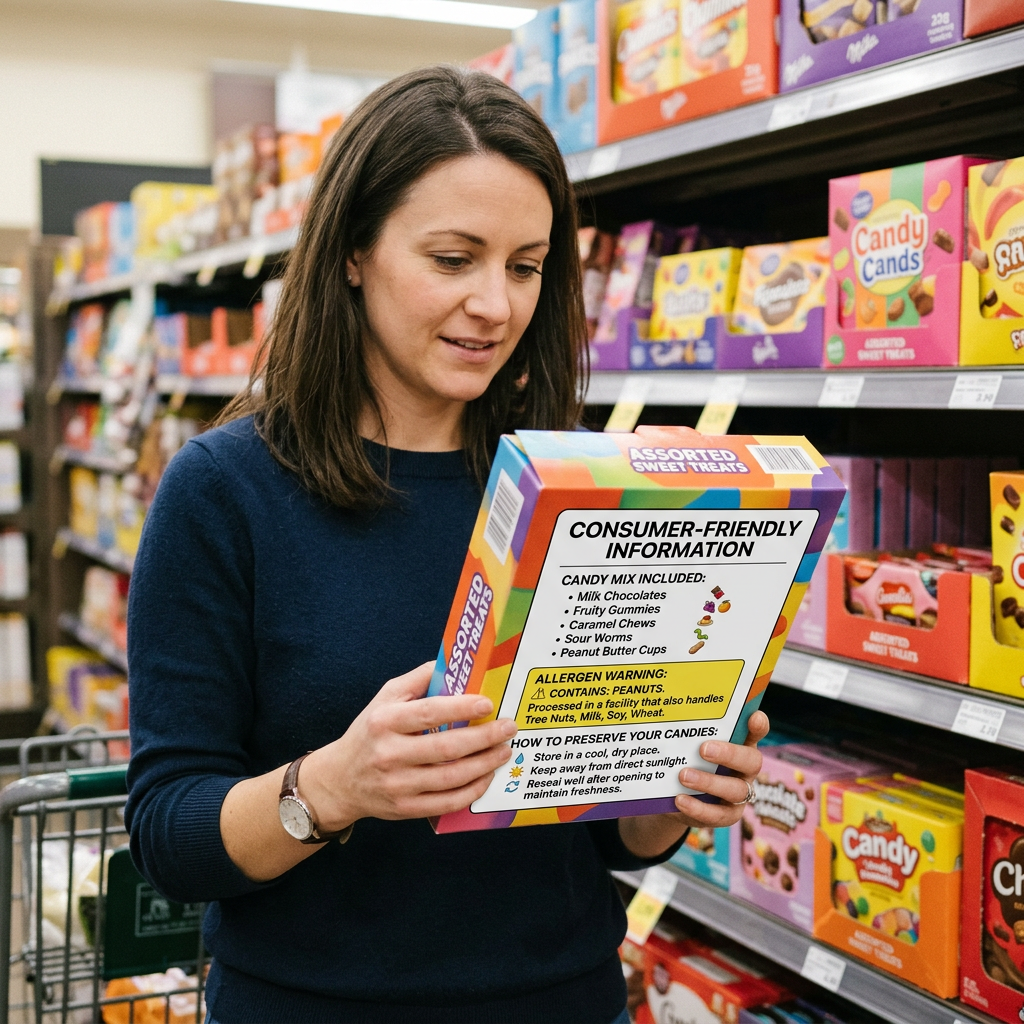
Buyers will select a box of candy, and then flip it around. They would like to know the various candy types contained within the box; if there is any nut content; and how best to preserve the candies.

When consumers cannot easily identify the desired information, many will simply replace the box. When providing consumer-friendly information to candy boxes, shopping feels less complicated.

Shopper reading an assorted sweet treats box labeled "CONSUMER-FRIENDLY INFORMATION," listing milk chocolates, fruity gummies, caramel chews, sour worms, and peanut butter cups; allergen warning states it contains peanuts and may contain tree nuts, milk, soy, and wheat; storage instructions recommend a cool, dry place and resealing after opening.
A shopper examines a candy assortment box displaying ingredients, allergen warnings, and storage instructions.

You should first establish which questions consumers typically inquire about when purchasing candy. As such, your sales associates are likely to receive these inquiries frequently. These common questions serve as an excellent starting point for developing consumer accessible information on your candy boxes.

The first step to establishing consumer-friendly information is identifying the candy varieties within the box. Although a variety box (a box containing multiple types of candies) may be visually appealing, consumers should not be required to “guess” what they are selecting.

Identify flavor names clearly. Identify whether the various candies contain any nuts. Clearly provide instructions regarding preservation. Establish descriptions using descriptive terms for the types of candies. For example, “dark chocolate caramel,” provides more insight into the candy being selected than does a generic term. Consider creating a fun name for your product and including a short description next to the name.

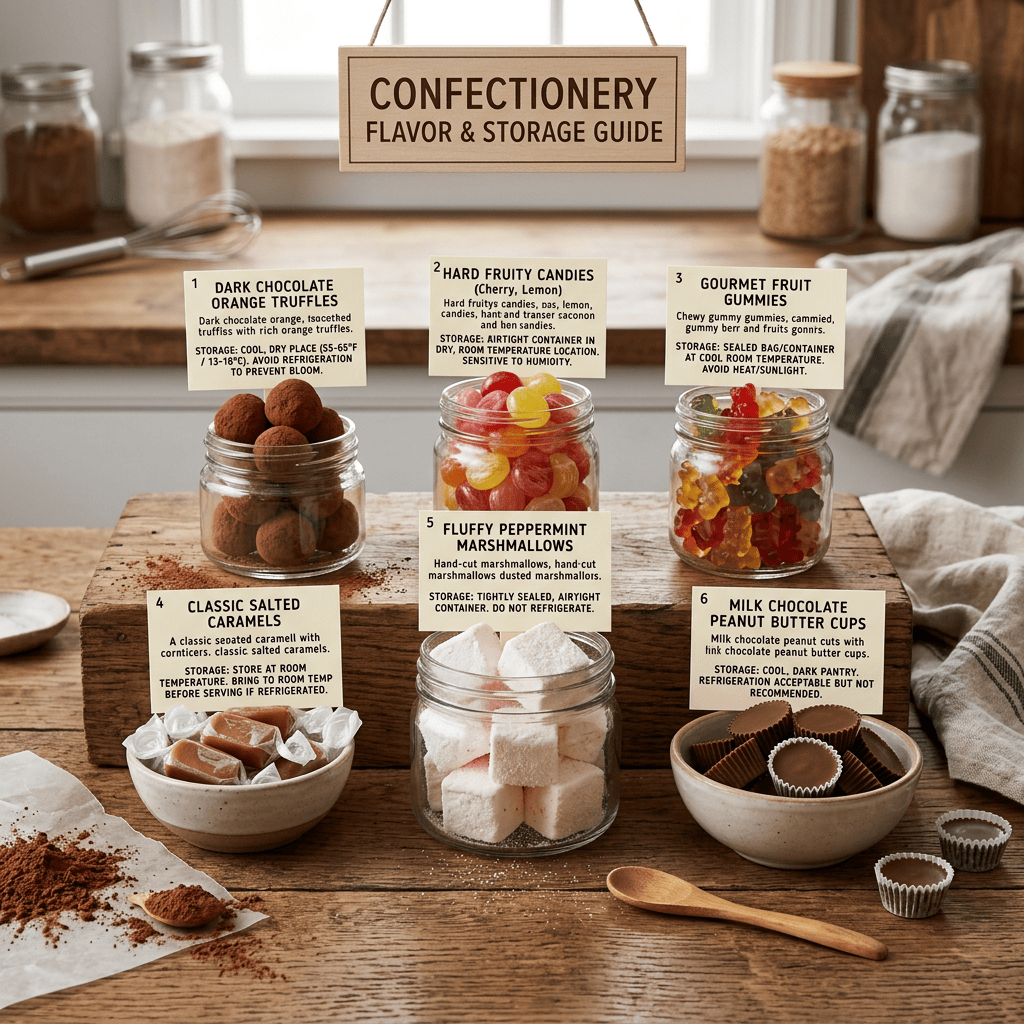
To assist in identifying the various candy selections, create a simple identification guide. Include a clear description for each candy selection utilizing either a picture or words that match the contents of the box. Ensure that this guide remains accurate and reflects changes made to your products’ mixes.

Tie product details directly to specific boxes. To avoid confusion when using similar packaging styles for two separate product lines, clearly label each product line. Your sales associates should be able to differentiate between each product line without having to open each box.

Product labeling, particularly ingredients and allergens, requires special consideration. Utilize validated data obtained from your recipes and suppliers. Do not rely upon anecdotal evidence, nor should you create “allergen-free” claims based solely on your memory.

Research local regulations prior to producing product labels. Allow sufficient space within your label design for any applicable regulatory information. Consider both the individual purchasing the candy and the intended recipient of the gift. Although the purchaser may have familiarity with your store, the recipient may not be aware of your store. Therefore, regardless of who receives the gift, your candy box should provide some level of relevant information.

In addition to providing flavor information, consider recommending storage methods that correspond to each type of candy. Various candy fillings and recipes may require unique handling practices. Unless each product corresponds to the recommended storage method, do not include a single recommendation for storing all products together.

Confectionery Flavor & Storage Guide; labels identify dark chocolate orange truffles, hard fruity candies, gourmet fruit gummies, classic salted caramels, fluffy peppermint marshmallows, and milk chocolate peanut butter cups.
Six homemade confectionery treats are displayed with flavor notes and storage recommendations.

Utilizing date or batch coding? Clearly label the location of these codes. Maintain documentation within your organization so that employees may correlate completed boxes with their respective production batches.

Prior to placing a bulk order for labels, produce a test label at full scale. Attach the test label to a fully filled box and evaluate it in a typical retail environment under standard lighting conditions. While small font characters may appear adequate on a computer monitor, they may prove difficult to read in a retail setting.

Request another employee who was not involved in designing the label to review it. Ask whether he/she could quickly locate the flavor information and storage guidelines.

Labels designed for consumer accessibility result in enhanced ease-of-use when making purchases from a candy box and facilitate communication between consumers and retailers.

Your Candy Boxes Might Be Losing You Money

You could make money at a candy store all year round, but if you don’t have an idea of what your true costs are, you’ll probably make almost nothing. Maybe it’s not even the candy itself. Even if you charge enough to cover the cost of the sugar and chocolate, you may still lose on packaging. Paper cups, candy boxes, labels, energy (electricity), broken pieces of candy – there are a lot of costs besides just the candy. Once you know what your true costs are, you can start turning your job into a successful business.

Knowing Your True Costs: The Secret to Sweet Success; candy shop owner calculating costs at a counter
A candy shop owner calculates product costs while planning for sweet business success.

Take one order of candies and write down everything that was spent on each ingredient. Small items like flavoring, nuts, oil and decorative items should also be included. Don’t include the entire cost of something (such as a large bag) simply because you only used some of it. Divide the total cost of the item by the portion used so the cost remains proportional to the usage.

After writing down all of the costs for this order, now find out how many individual pieces of candy were made. Do not include broken pieces of candy; test pieces; or pieces of candy that were sampled. Since you know how much it cost to produce this order ($30) and how many pieces of candy fit to sell (100), now calculate the cost per piece of candy prior to packaging. For example, since each piece of candy has a cost of 30 cents prior to packaging, a box containing 10 pieces would contain $3.00 worth of candy.

Costs associated with packaging belong in the calculations. In addition to the candy box and cup, you must consider other costs such as pads, ribbon, stickers, printed cards and any outer bags used for sales. Although a few cents might seem insignificant to track, multiple small items can equal more than a dollar. This lost dollar can become thousands of dollars over the course of numerous orders.

There is another expense that sellers commonly overlook — time. Determine how long it took to prepare, cook, cool, sort, pack, seal, and clean up after completing one order. Next, choose a reasonable hourly wage based upon your desired compensation. Finally, divide this hourly wage by the number of completed boxes to determine if a specific cost related to a box (i.e., a fancy bow or handwritten label) has taken longer than what you believe customers will pay for.

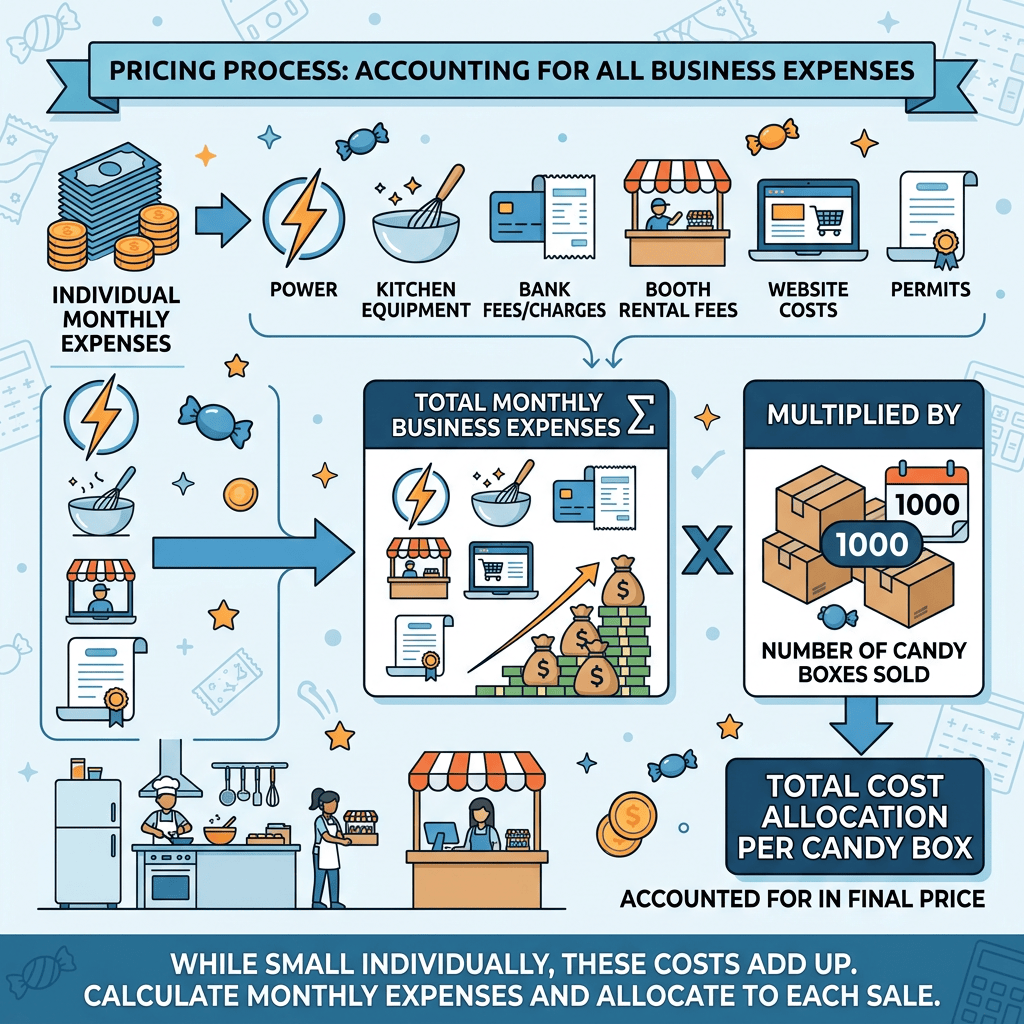
Infographic text: “PRICING PROCESS: ACCOUNTING FOR ALL BUSINESS EXPENSES”; individual monthly expenses include power, kitchen equipment, bank fees/charges, booth rental fees, website costs, and permits; total monthly business expenses multiplied by number of candy boxes sold equals total cost allocation per candy box, accounted for in final price; “While small individually, these costs add up. Calculate monthly expenses and allocate to each sale.”
An infographic shows how monthly business expenses are calculated and allocated across each candy box sold.

All business expenses that benefit each sale (power, kitchen equipment, bank fees/charges, booth rental fees at markets, website costs and permits) need to be accounted for in the pricing process. While these costs may be small individually, they can quickly add up. When accounting for these costs you must multiply them by the number of candy boxes sold during a month.

Now combine the total cost for candy, packaging, labor and shared business expense for one box. This is referred to as your “break-even” point (not your selling price). To maintain profitability and provide funds to replace tools and equipment and account for slower sales periods you must add a markup to exceed this break-even point. There isn’t a standard mark-up for all shops since local buyers and quality of product vary greatly.

Finally, review your final price compared to those similar treats being sold within the same general area. Is your price significantly higher than others? If so, you likely use better ingredients, give customers larger portions or provide a unique service to justify this increased price. On the other hand, if your price is lower than comparable products sold near you it may indicate that a cost was left unaccounted for. Re-evaluate your calculation when suppliers increase prices on supplies. Accurate records enable sellers to establish fair pricing and clearly communicate with consumers regarding quantity discounts or special promotions and gifts given away at community events without unknowingly damaging their personal financial income.